Crop rotation, grassing over and green manure were the traditional agricultural techniques used to ensure soil health – that is, the living ecosystem that maintains the soil’s fertility.
Superseded by industrial chemicals and extensive mechanisation – which, with the advent of monoculture, have helped to radically transform the agricultural landscape – these techniques are now being rediscovered through so-called regenerative or conservation agriculture.
This reflects a growing realisation that the soil is not merely a substrate to be broken up, sterilised or fertilised, but a heritage to be safeguarded and nurtured.
Therefore, the aim is to increase organic matter and microbial activity, to carry out minimal tillage so as not to damage the soil structure, to keep the soil covered to prevent erosion whilst promoting biodiversity. And, no less importantly, to ensure livestock farming to close the natural nutrient cycle.
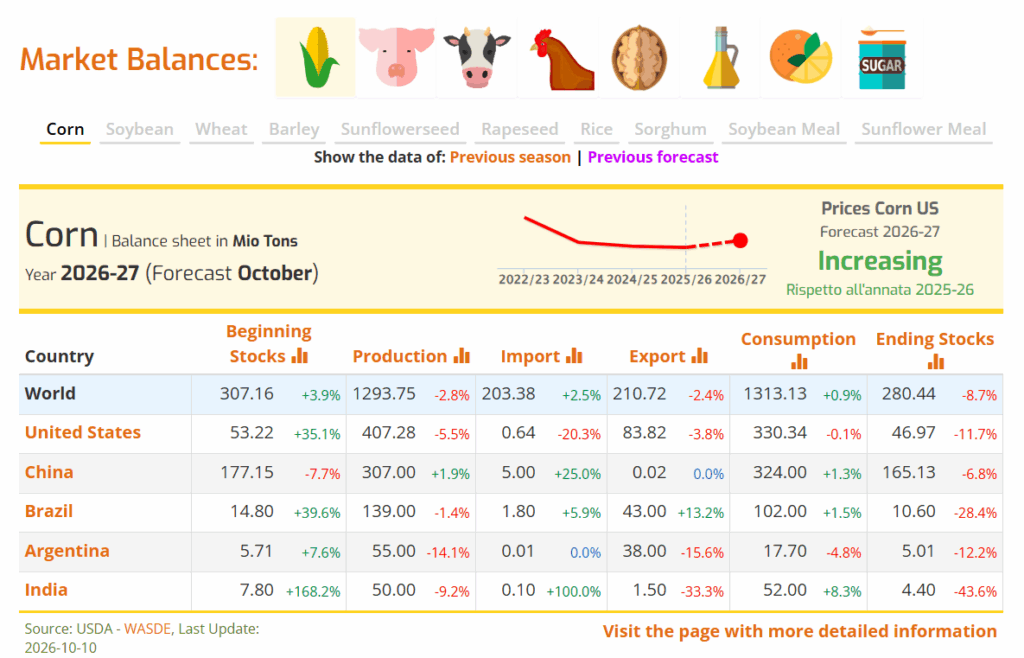
The balance between supply and demand is a key tool for understanding a market. TESEO’s homepage provides monthly updated balances for many cereals, oilseeds and some derived products. Here are the key updates from the latest outlook for the 2026/27 season:
🌽 Corn: Despite improved estimates for US availability, production is expected to decline compared with the 2025/26 season, both in the United States and globally, putting pressure on stocks. EU production is forecast to fall by 15.6%.
🌾 Wheat: The outlook for global stocks and exports is worsening, with both expected to decline compared with the previous season. Russia is expected to record the largest drop in exports, while Canada and Australia remain key suppliers on the international market.
🫘 Soybeans: Production and exports are expected to increase, driven mainly by the United States, while stocks are set to remain stable. Brazilian production is also forecast to grow by 3%. Its progress will be important to monitor in assessing South American supply and trade flows.
by H S Oberoi, President of Parag Milk Foods Ltd (India)
The year 2017 has not been good in India, because of high milk prices and low rate of milk products. Because of this, profit margins have been low. Now from June onwards, there has been reduction in milk price and we are entering into flush season from Sept/October 2017 and milk prices looks to be stable in future till April 2018.
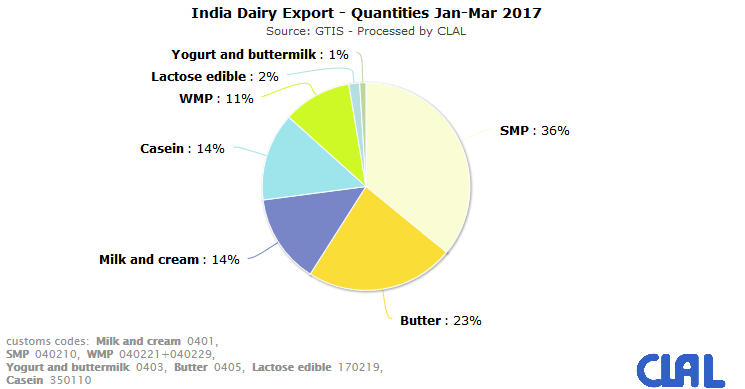
Sharp fall in the international market prices of dairy products attributed to reduced demand from China and Russia and higher production by EU and New Zealand led to deep decline in exports of SMP from India.
CLAL.it – Indian Dairy Export
Dropped drastically to just 25000MT in fiscal 2015 year from over 125000MT the previous year. In the international prices currently Butter prices have increased to level of about 5768 USD/MT but still the domestic prices of Butter/Ghee (Anhydrous Fat) are high in India and therefore no possibilities of export. India is big consumer of Butter/Ghee and therefore no surplus milk fat is available for export.
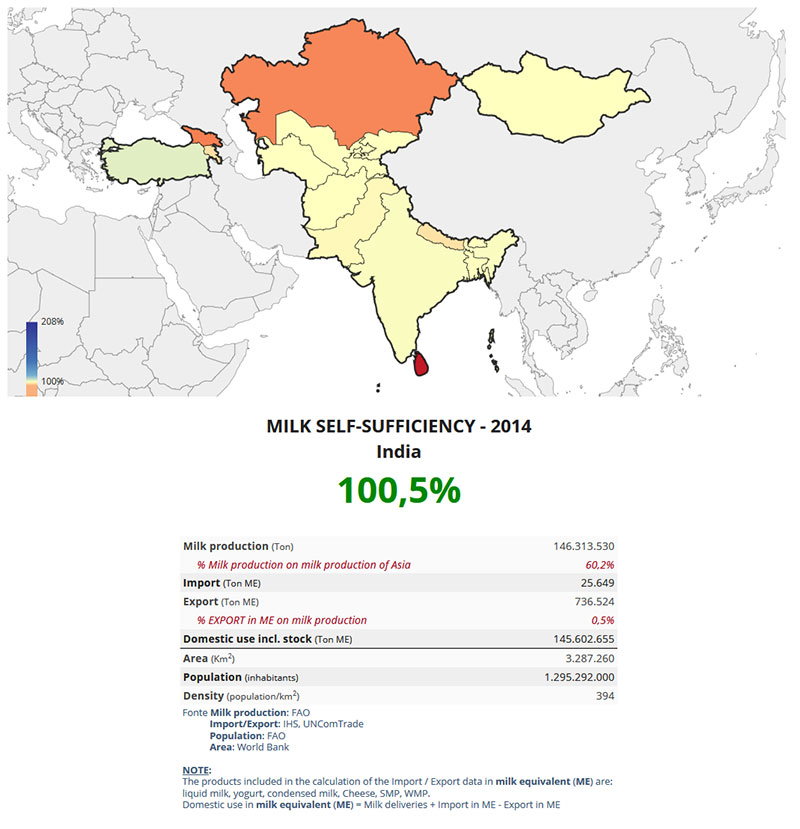
Milk production in India is growing at CAGR (Compound Annual Growth Rate) of about 4%. At Present milk production is 150 million tons per annum, which is 18% of world milk production. Only 21% milk produced in India is processed in organized sector. The unorganized sector is converting into organized sector and therefore lot of scope in adding new infrastructure. India needs about 1400 million Euros investments in next five years.
Despite India being largest milk producer in the world, India accounts for negligible share in world Dairy trade. Growing income, large untapped domestic market opportunities, potential to add value for higher margin products, deeper distribution, penetration, evolving role of modern retail, leads to exciting future in Dairy Sector.
Current market of Dairy Sector is estimated at 7000 million euro’s and growth of this sector is impressive at 700 million euro’s per year covering various products as indigenous products, value added products such as probiotics, prebiotics and fortifications. It would create more options and choice of consumers. Make at home products would see further conversion towards convenience driven formats.
The next decade would see the dairy sector emerge as one of the largest evolved segment with in food sector in India.