












































China: renewed momentum in Cereal imports
27 October 2026

by Elisa Donegatti

After slowing in 2025, China’s cereal imports have picked up pace, increasing by 50.9% in the January–September 2026 period. Imports of corn, which saw a 126% increase, as well as sorghum and barley, have been particularly robust. 

The recovery is mainly driven by rising domestic prices, also linked to quality issues affecting part of the Corn crop, as well as the greater price competitiveness of imported raw materials.

FAS-USDA estimates that the share of Corn used in animal feed in China fell from 47% in January to 29% in August 2026, in favour of other cereals such as Wheat, Barley and Sorghum, with Pig producers particularly focused on feed costs.
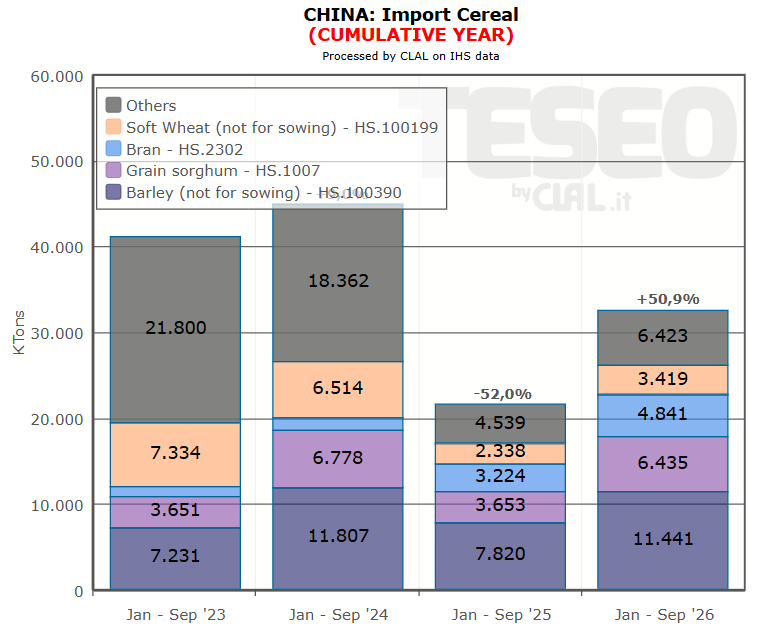
TESEO.clal.it – China: Cereal imports

Triple Superphosphate: How Much Does the Price Increase Weigh on Crop Revenues?
20 October 2026

by Elisa Donegatti

46% Granular Triple Superphosphate is a Fertilizer that helps promote root development and support the early growth of crops. In Italy, autumn is a key period for fertilizer applications to winter-sown crops, while farmers also plan their Fertilizer purchases for the following spring’s corn crop. As a result, fertilizer costs are once again in focus. 

In Turin, Italy, prices have risen by €80/t in one month, reaching €725–735/t in early October. The increase is partly driven by geopolitical tensions in the Middle East, which are affecting maritime transport and the availability of raw materials such as sulphur, increasing costs and uncertainty over supplies.

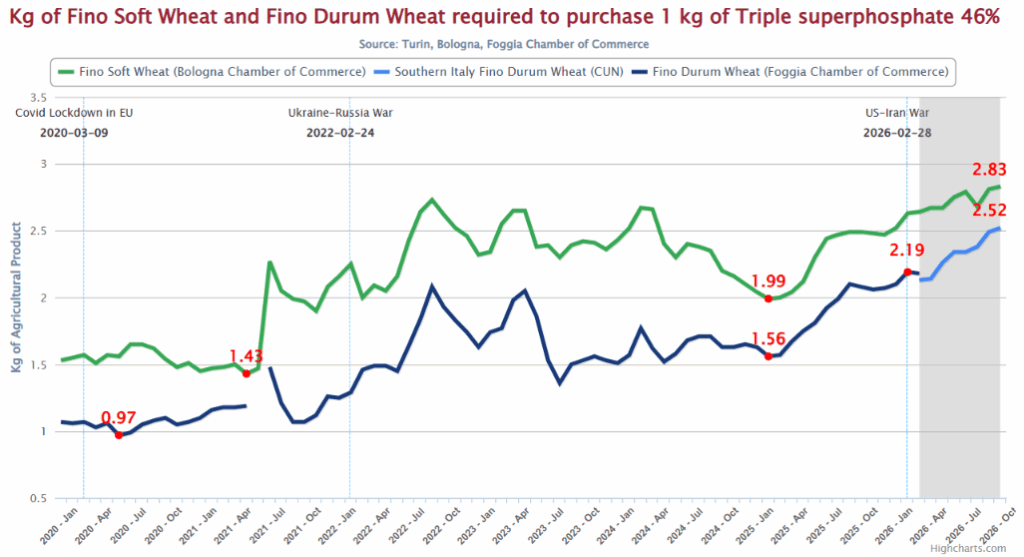
How much does the price increase weigh on crop revenues? The price ratio between Fertilizer and cereals has increased. It now takes approximately 2.73 kg of Corn or 2.83 kg of Soft Wheat to purchase 1 kg of triple superphosphate. Rising Fertilizer prices mean farmers must sell more grain to pay for the same amount of Fertilizer.

TESEO.clal.it – kg of Wheat required to purchase 1 kg of Triple superphosphate

Outlook for the Coming Season: Corn, Wheat and Soybeans
13 October 2026

by Elisa Donegatti

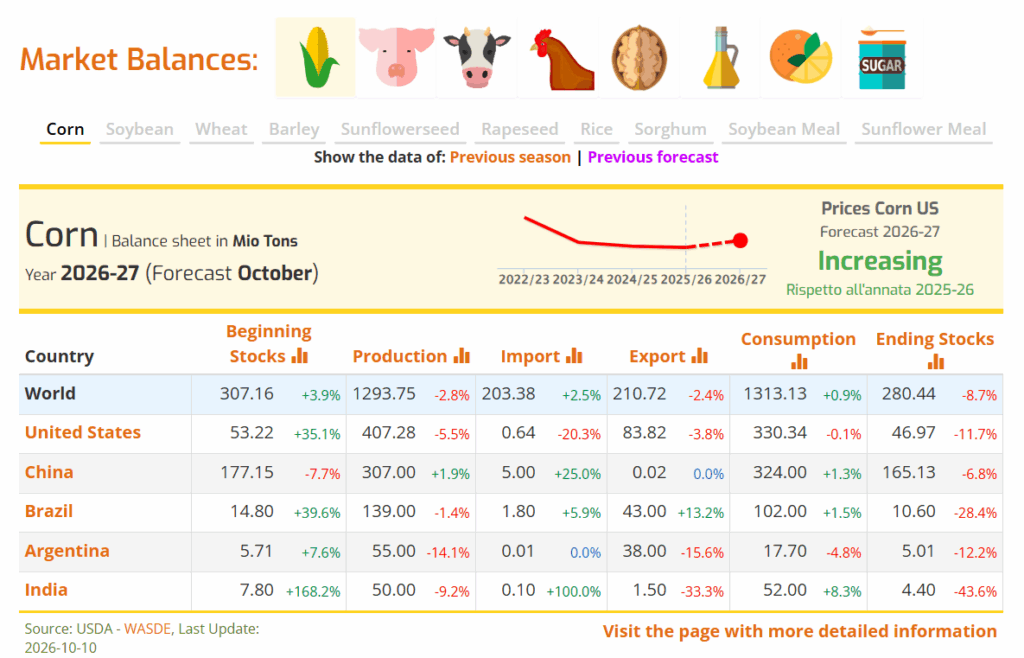
The balance between supply and demand is a key tool for understanding a market. TESEO’s homepage provides monthly updated balances for many cereals, oilseeds and some derived products. Here are the key updates from the latest outlook for the 2026/27 season:

🌽 Corn: Despite improved estimates for US availability, production is expected to decline compared with the 2025/26 season, both in the United States and globally, putting pressure on stocks. EU production is forecast to fall by 15.6%.

🌾 Wheat: The outlook for global stocks and exports is worsening, with both expected to decline compared with the previous season. Russia is expected to record the largest drop in exports, while Canada and Australia remain key suppliers on the international market.

🫘 Soybeans: Production and exports are expected to increase, driven mainly by the United States, while stocks are set to remain stable. Brazilian production is also forecast to grow by 3%. Its progress will be important to monitor in assessing South American supply and trade flows.

Explore the balances for Soybean Meal, Barley, Sunflower Seed, Rapeseed, Rice, Sorghum and Sunflower Meal on TESEO.clal.it >