













































Pig prices in Italy could recover in the second quarter of 2027 [Commentary by Lorenzo Levoni]
20 November 2026

Lorenzo Levoni, CEO of Modena-based Alcar Uno

By Marika De Vincenzi

“The European pig sector is facing a difficult situation, with more pigs than the market can absorb. Consumption remains subdued, even though pork provides high-quality protein and is more competitively priced than beef, which has become significantly more expensive, and poultry, whose prices have risen in recent months. Yet there is a campaign against cured meats in particular on health grounds, which is dampening consumption of some products.”

Lorenzo Levoni, CEO of Modena-based Alcar Uno, describes a challenging situation for the pork supply chain, compounded by rising energy costs, from fuel to electricity, as well as higher logistics and transport costs. Prices have also risen for the agricultural commodities that form the basis of feed rations for pigs and other livestock.

“Exports have also slowed as African swine fever shows little sign of receding in some parts of Europe. With less EU production reaching international markets, there is less upward pressure on prices,” Levoni explains. “The ASF situation in the Po Valley still seems far from improving, although some municipalities in the province of Pavia and in Piedmont are no longer in restricted zones. Much remains to be done, and securing regionalisation to allow exports looks quite difficult.”

There may be some room for improvement if pork production falls. “The downturn in the fresh pork market has prompted farmers to limit their losses by slaughtering more sows. This is expected to reduce pig production as early as next spring,” Levoni says.

“Italy raises heavy pigs and therefore has a longer production cycle. Its sow herd also appears to have shrunk less than elsewhere. This suggests that pig prices could recover more slowly in Italy than in the rest of Europe, with prices likely to start rising in the second quarter of 2027.”

Overall, however, climate change and rising production costs throughout the supply chain could also push up consumer prices. How this will affect consumption remains to be seen.
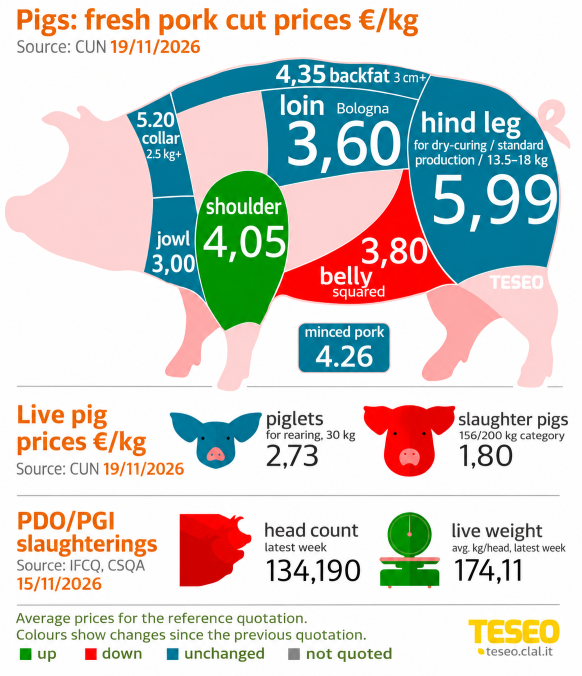
TESEO.clal.it – Pigs prices

Pork market: Brazil seeks new opportunities as Europe faces falling prices
13 November 2026

By Marika De Vincenzi

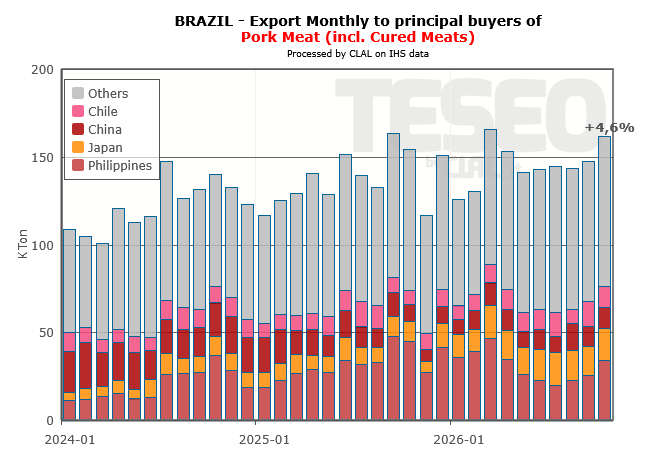
In October 2026, Brazilian pork exports increased by 4.6% in volume compared to the same month in 2025, reaching 161,300 tonnes. Meanwhile, export value declined by 6.5% (down USD 23 million).

Shipments of fresh, chilled and frozen pork, which account for over 80% of total exports, increased to Japan (+62.4%) and Chile (+59.5%), but declined to the Philippines (−27.4%), which nevertheless remained Brazil’s largest export destination during the first ten months of 2026.

The decline in shipments to the Philippines is particularly significant in light of the government’s recent decision to suspend imports of certain pork products and offal for 60 days, a measure that has been approved but has not yet taken effect.

Brazil is therefore facing growing trade uncertainty, as export volumes continue to rise while average unit values decline.

For the EU, the risk is an intensification of international competition: a potential redirection of Brazilian exports towards other markets could increase pressure on European suppliers, already facing declining pork prices.

TESEO.clal.it – Brazil: Export of Pork Meat

Beef: Brazil strengthens traceability for the European market
12 November 2026

by Marika De Vincenzi

Brazil aims to strengthen traceability across its cattle supply chain to demonstrate compliance with European rules against deforestation. The EU Deforestation Regulation (EUDR) requires that cattle and beef placed on the EU market do not originate from land deforested after 31 December 2020.

To meet these requirements, the Brazilian Ministry of Agriculture has presented Agro Brasil + Sustentável, a public platform that cross-references official records and geographic information to assess the environmental status of farms. For the cattle sector, the Ministry also outlined the checks carried out by slaughterhouses to verify the origin of animals.

The information collected could help European importers carry out their compliance checks, without replacing the obligations established under the EUDR.

For Italian and European cattle farmers, this is a relevant development: Brazil is taking steps to maintain access to the EU market, where the ability to document cattle origin and compliance with environmental requirements is becoming an increasingly important factor in competition among suppliers.

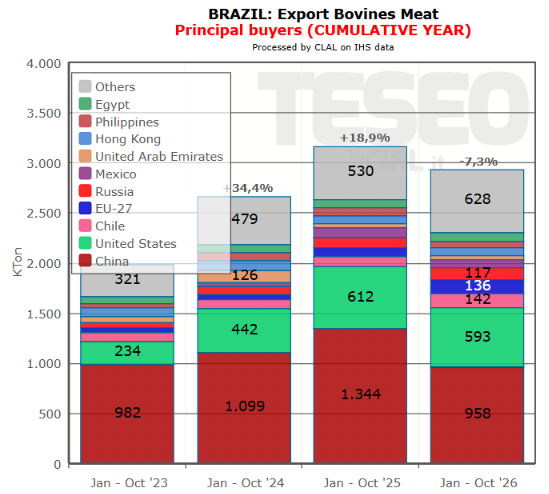
Teseo.clal.it – Brazilian beef exports

Philippines: possible restrictions on pork imports – what could be the consequences for the EU?
6 November 2026

by Marika De Vincenzi

The Philippine pork market is facing a challenging period, characterized by declining farmgate prices, negative profitability for many farmers and rising cold storage inventories. According to the Department of Agriculture, growing imports are intensifying competition for domestic producers.

To support local farmers, the Philippine government has launched a safeguard investigation, notified to the World Trade Organization (WTO) on October 21, and is considering higher tariffs and possible import restrictions. No final measures have been adopted yet.

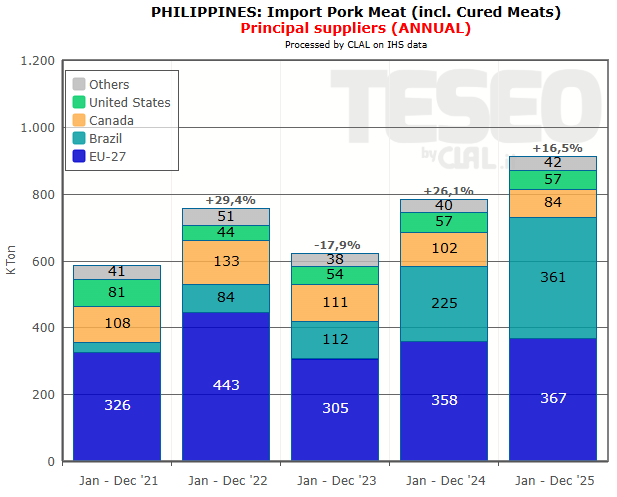
According to CLAL analysis, in 2025 the Philippines imported 911,000 tonnes of pork and processed pork products (+16.5% year-on-year), including 367,000 tonnes from the EU (40% of the total), broadly in line with Brazil (361,000 tonnes).

The main imported categories were fresh, chilled and frozen pork (463,000 tonnes) and pork offal (301,000 tonnes). Major European suppliers included Denmark, Spain, The Netherlands and France.

The consequences could also indirectly affect Italy: in 2025, Denmark, Spain, the Netherlands and France supplied a combined 581,000 tonnes of pork to Italy, accounting for approximately 47% of total Italian pork imports.

Potential Philippine import restrictions could redirect part of the European pork supply towards other markets, including Italy, increasing downward pressure on pork prices. This could have negative repercussions for the Italian pork market, even if indirectly.

TESEO.clal.it – Philippines: Pork Imports

Meat consumption in Italy: beef prices accelerate, while other meat prices remain more stable
30 October 2026

by Marika De Vincenzi

Retail consumption of fresh meat in Italy showed diverging trends in the first nine months of 2026. According to CLAL’s analysis of Circana data (covering hypermarkets, supermarkets, small supermarkets and specialist food retailers), purchases of fresh pork increased by 6.2% in volume, while those of beef declined by 6.2%. Poultry and rabbit meat consumption remained broadly stable (+0.2%).

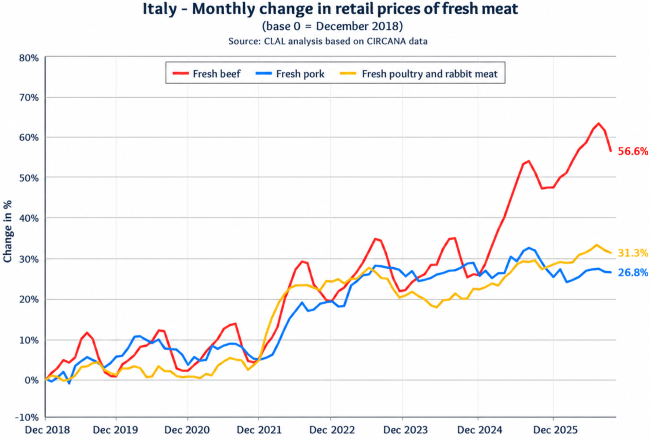
Consumer price trends have undoubtedly contributed to this scenario. As shown in the chart, which illustrates changes in retail prices compared with December 2018, beef prices have risen sharply since late 2024, widening the gap with pork, poultry and rabbit meat, whose prices have remained relatively stable in recent years.

These dynamics highlight growing pressure on beef’s competitiveness compared with other types of meat, as declining household purchasing power increasingly influences consumer spending decisions.

The cured meat and cold cuts segment also shows diverging trends: in the first nine months of 2026, purchase volumes of cooked ham (Prosciutto Cotto) declined by 4.8% and mortadella by 4.7%, while dry-cured ham (Prosciutto Crudo) increased by 2.5%. Growth was particularly strong in the non-PDO segment (+4.1%), also supported by a 1.2% decrease in average prices in this category.

TESEO.clal.it – Monthly change in retail prices (base 0 = December 2018)

China: renewed momentum in Cereal imports
27 October 2026

by Elisa Donegatti

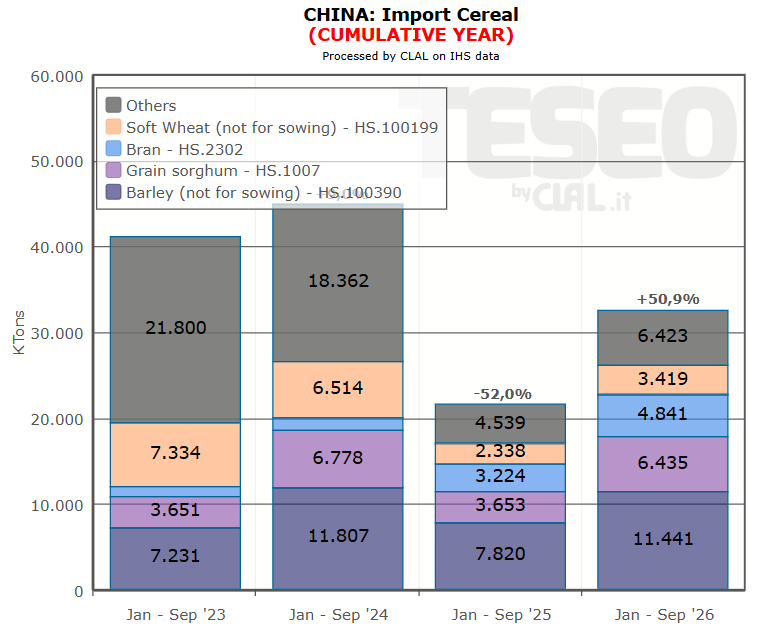
After slowing in 2025, China’s cereal imports have picked up pace, increasing by 50.9% in the January–September 2026 period. Imports of corn, which saw a 126% increase, as well as sorghum and barley, have been particularly robust. 

The recovery is mainly driven by rising domestic prices, also linked to quality issues affecting part of the Corn crop, as well as the greater price competitiveness of imported raw materials.

FAS-USDA estimates that the share of Corn used in animal feed in China fell from 47% in January to 29% in August 2026, in favour of other cereals such as Wheat, Barley and Sorghum, with Pig producers particularly focused on feed costs.

TESEO.clal.it – China: Cereal imports

China: shifting consumption patterns put increasing pressure on the Pork Market
23 October 2026

by Marika De Vincenzi

After years of production expansion, partly driven by efforts to recover from the African Swine Fever (ASF) crisis of 2018–2019, China’s pork market is now facing weaker domestic demand and prices under pressure.

According to the latest USDA estimates, pork consumption in China is expected to decline slightly in 2026 (-0.1%, a seemingly small change that still carries weight given the large volumes involved), reaching 60.35 million tonnes. In contrast, chicken meat consumption is forecast to increase by 7.2%, reaching 16.84 million tonnes.

Different trends are also emerging on the production side. China produced 59.4 million tonnes of pork in 2025, with a further 0.5% increase expected in 2026. Chicken meat production, which reached 16.5 million tonnes in 2025, is forecast to grow by 9.1% in 2026.

Meanwhile, new signals are emerging in international trade. Between January and September 2026, China exported nearly 158,000 tonnes of pork (exclusively to neighbouring Asian markets), up 24% compared with the same period in 2025 and as much as 91% compared with January–September 2023.

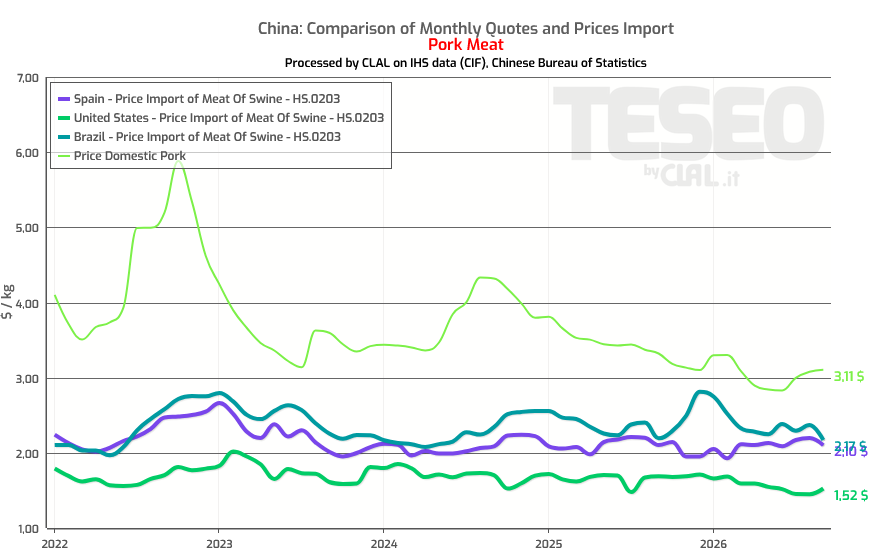
Although export volumes remain limited compared with those of the world’s leading pork exporters, this trend suggests a growing effort to find overseas outlets to absorb China’s substantial domestic production capacity. This is particularly significant considering that Chinese-produced pork is more expensive than competing imported products available on the Chinese market, including those from Brazil, the United States and Spain.

Triple Superphosphate: How Much Does the Price Increase Weigh on Crop Revenues?
20 October 2026

by Elisa Donegatti

46% Granular Triple Superphosphate is a Fertilizer that helps promote root development and support the early growth of crops. In Italy, autumn is a key period for fertilizer applications to winter-sown crops, while farmers also plan their Fertilizer purchases for the following spring’s corn crop. As a result, fertilizer costs are once again in focus. 

In Turin, Italy, prices have risen by €80/t in one month, reaching €725–735/t in early October. The increase is partly driven by geopolitical tensions in the Middle East, which are affecting maritime transport and the availability of raw materials such as sulphur, increasing costs and uncertainty over supplies.

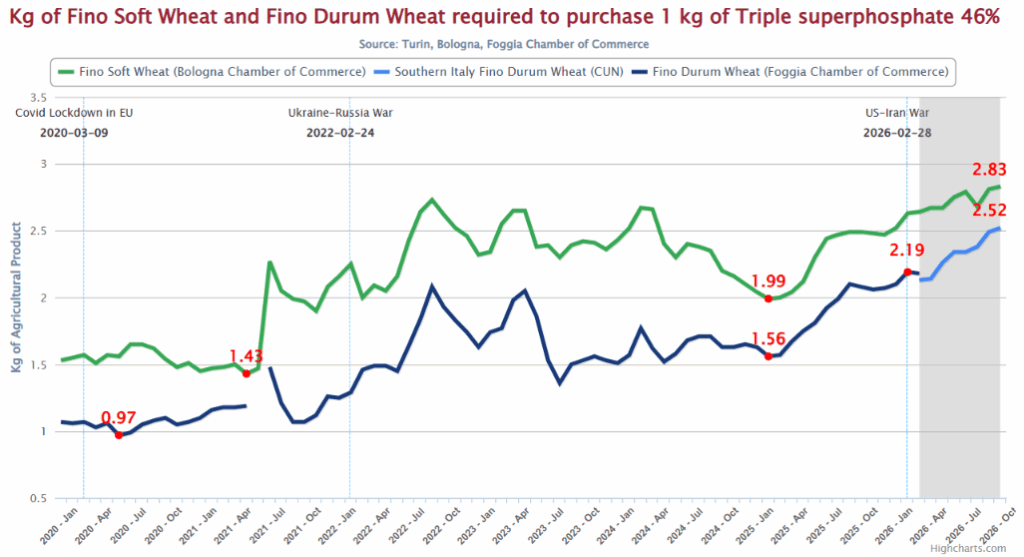
How much does the price increase weigh on crop revenues? The price ratio between Fertilizer and cereals has increased. It now takes approximately 2.73 kg of Corn or 2.83 kg of Soft Wheat to purchase 1 kg of triple superphosphate. Rising Fertilizer prices mean farmers must sell more grain to pay for the same amount of Fertilizer.

TESEO.clal.it – kg of Wheat required to purchase 1 kg of Triple superphosphate

Maritime Shipping: Freight Rates Decline, but Geopolitical Tensions Persist
19 October 2026

By Alberto Lancellotti

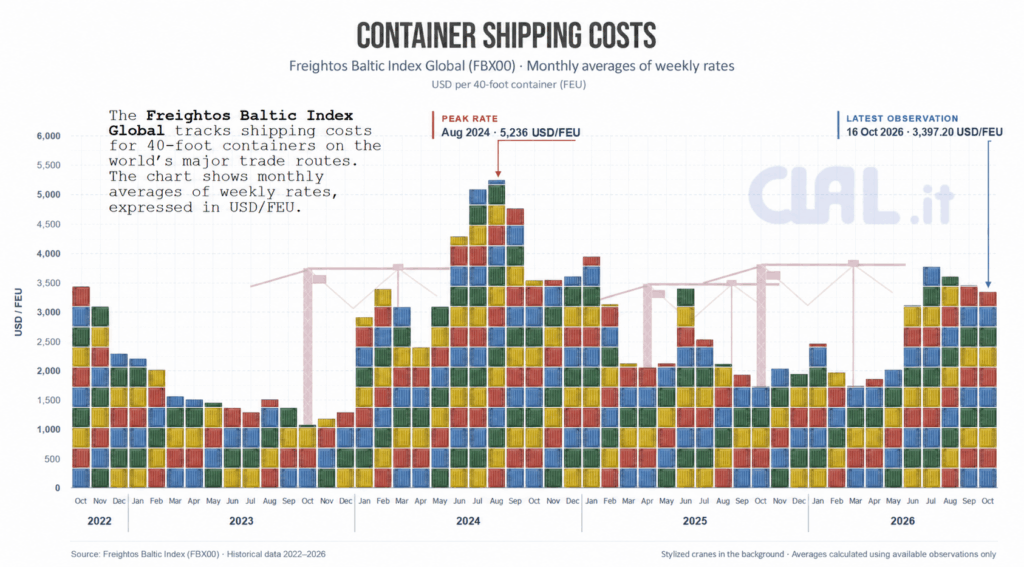
📊 The Freightos Baltic Index Global stood at USD 3,397 per 40-foot container in mid-October, down from summer levels.

The decline in freight rates on Asia–Europe routes mainly reflects the seasonal slowdown in shipments and the gradual return of vessels through the Suez Canal, which is increasing available shipping capacity.

🚢 However, signs of recovery are emerging: Asia–Mediterranean freight rates rose by 7% over the past week, with rates on both this route and those to Northern Europe remaining approximately 70% higher than a year ago.

Port congestion continues to support freight rates, while renewed geopolitical tensions increase the risk of disruptions in the Red Sea.

📉 Looking ahead, fleet expansion and increased shipping capacity could lead to further declines in freight rates in 2027, although significant uncertainty remains.

EU pork: Supply grows, increasing pressure on prices
16 October 2026

by Marika De Vincenzi

EU pork production continues to grow: following a 3.6% increase in 2025, production rose by a further 1.4% in the first seven months of 2026 compared with the same period of the previous year.

In contrast, extra-EU pork exports declined by 3.4% in volume and 17.6% in value.

The EU has a self-sufficiency rate of 115%, with significant differences between countries: from Denmark (576.5%) and Spain (163.9%) to Italy (58.1%).

The increased availability of pork, combined with weaker export opportunities, could intensify competition within the European market.

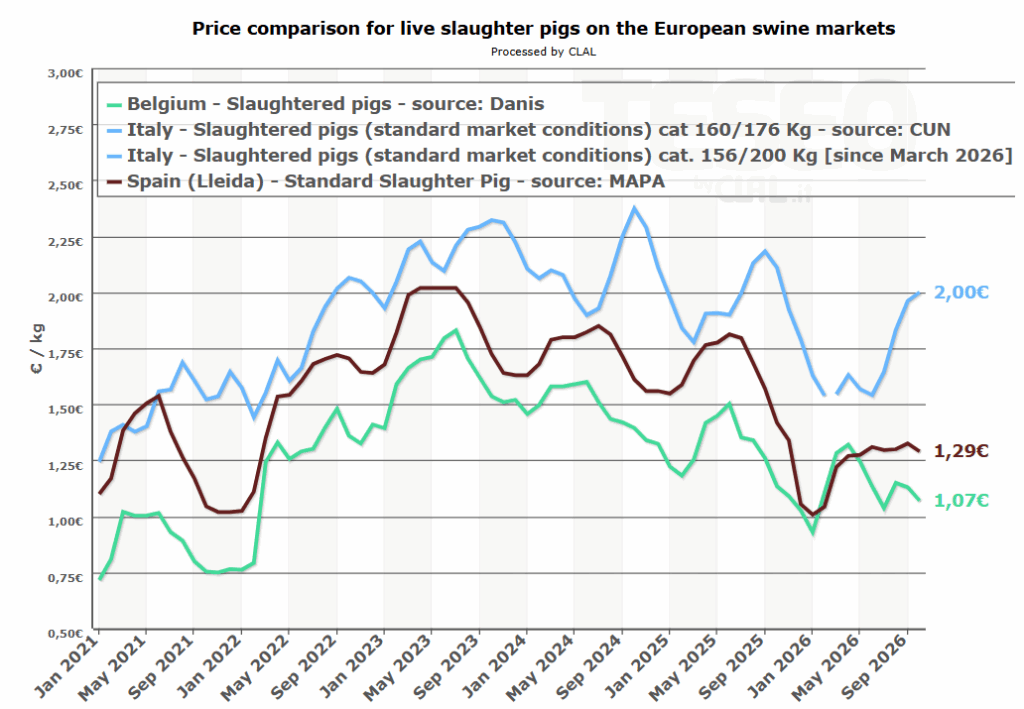
The price comparison between Italy, Spain and Belgium (see chart) highlights significant differences between national markets, partly reflecting their different production systems.

Against a backdrop of growing European pork supply, the Italian pork supply chain’s ability to capitalise on its distinctive production characteristics – including in export markets and higher-value market segments – will be crucial to maintaining its price premium over other European countries.

Teseo.clal.it – EU Slaughter Pig Prices