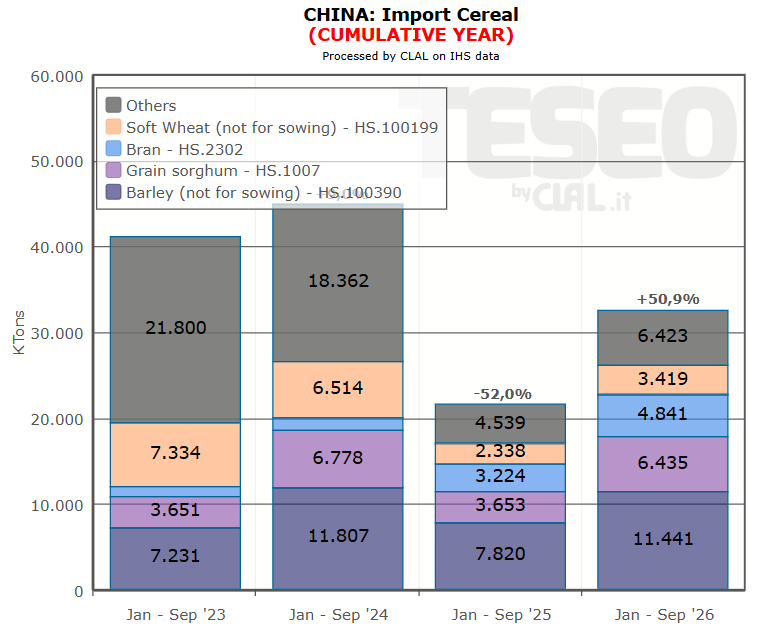
After slowing in 2025, China’s cereal imports have picked up pace, increasing by50.9% in the January–September 2026 period. Imports of corn, which saw a 126% increase, as well as sorghum and barley, have been particularly robust.
The recovery is mainly driven by rising domestic prices, also linked to quality issues affecting part of the Corn crop, as well as the greater price competitiveness of imported raw materials.
FAS-USDA estimates that the share of Corn used in animal feed in China fell from 47% in January to 29% in August 2026, in favour of other cereals such as Wheat, Barley and Sorghum, with Pig producers particularly focused on feed costs.
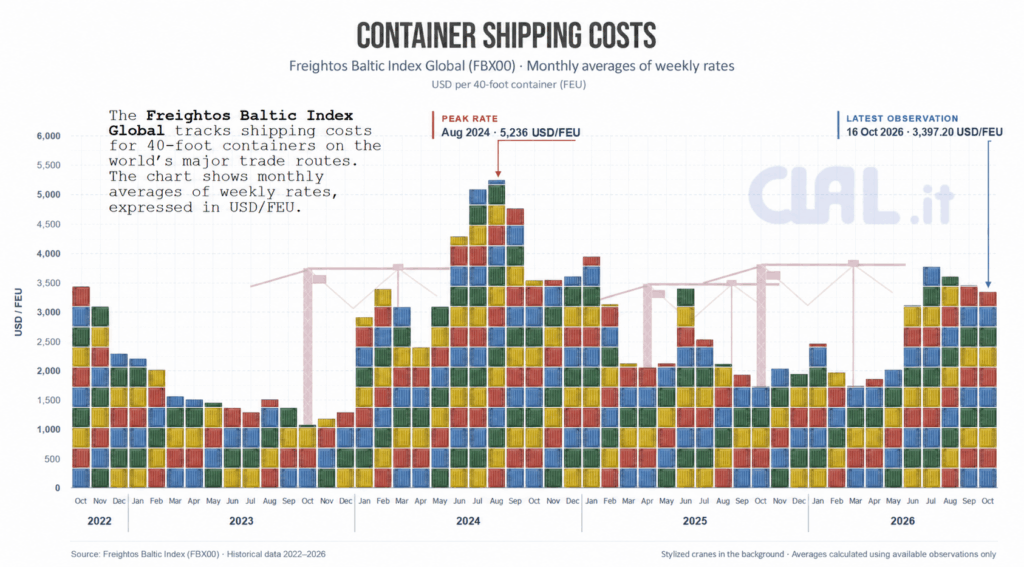
📊 The Freightos Baltic Index Global stood at USD 3,397 per 40-foot container in mid-October, down from summer levels.
The decline in freight rates on Asia–Europe routes mainly reflects the seasonal slowdown in shipments and the gradual return of vessels through the Suez Canal, which is increasing available shipping capacity.
🚢 However, signs of recovery are emerging: Asia–Mediterranean freight rates rose by 7% over the past week, with rates on both this route and those to Northern Europe remaining approximately 70% higher than a year ago.
Port congestion continues to support freight rates, while renewed geopolitical tensions increase the risk of disruptions in the Red Sea.
📉 Looking ahead, fleet expansion and increased shipping capacity could lead to further declines in freight rates in 2027, although significant uncertainty remains.
by H S Oberoi, President of Parag Milk Foods Ltd (India)
The year 2017 has not been good in India, because of high milk prices and low rate of milk products. Because of this, profit margins have been low. Now from June onwards, there has been reduction in milk price and we are entering into flush season from Sept/October 2017 and milk prices looks to be stable in future till April 2018.
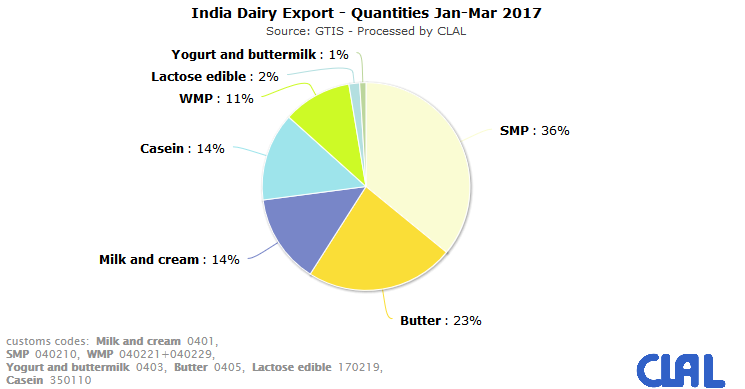
Sharp fall in the international market prices of dairy products attributed to reduced demand from China and Russia and higher production by EU and New Zealand led to deep decline in exports of SMP from India.
CLAL.it – Indian Dairy Export
Dropped drastically to just 25000MT in fiscal 2015 year from over 125000MT the previous year. In the international prices currently Butter prices have increased to level of about 5768 USD/MT but still the domestic prices of Butter/Ghee (Anhydrous Fat) are high in India and therefore no possibilities of export. India is big consumer of Butter/Ghee and therefore no surplus milk fat is available for export.
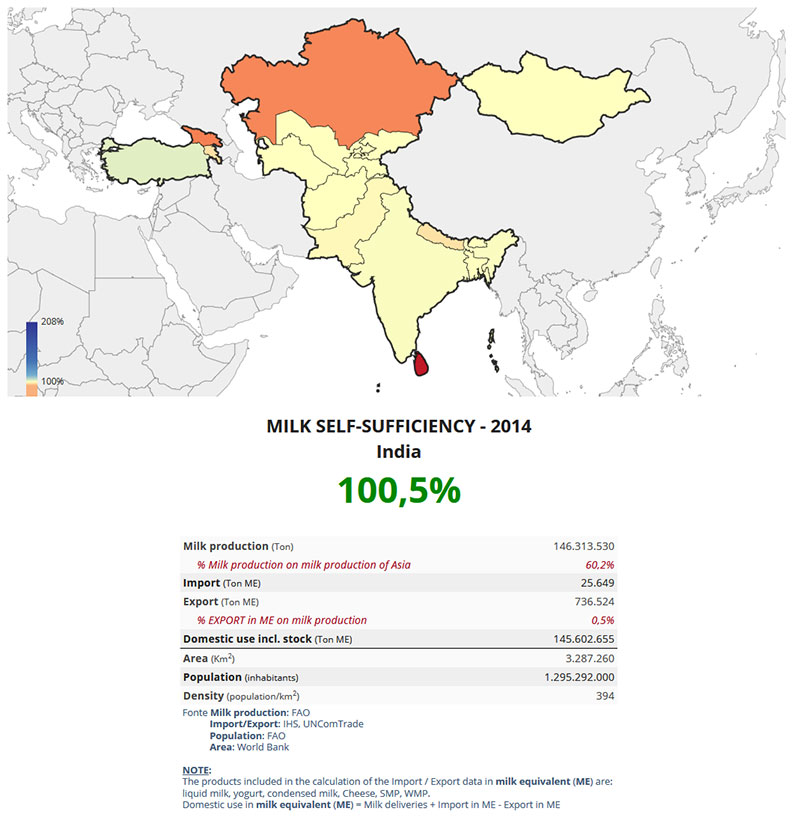
Milk production in India is growing at CAGR (Compound Annual Growth Rate) of about 4%. At Present milk production is 150 million tons per annum, which is 18% of world milk production. Only 21% milk produced in India is processed in organized sector. The unorganized sector is converting into organized sector and therefore lot of scope in adding new infrastructure. India needs about 1400 million Euros investments in next five years.
Despite India being largest milk producer in the world, India accounts for negligible share in world Dairy trade. Growing income, large untapped domestic market opportunities, potential to add value for higher margin products, deeper distribution, penetration, evolving role of modern retail, leads to exciting future in Dairy Sector.
Current market of Dairy Sector is estimated at 7000 million euro’s and growth of this sector is impressive at 700 million euro’s per year covering various products as indigenous products, value added products such as probiotics, prebiotics and fortifications. It would create more options and choice of consumers. Make at home products would see further conversion towards convenience driven formats.
The next decade would see the dairy sector emerge as one of the largest evolved segment with in food sector in India.